Space weather.
A clearer view of the night sky.
Explore official observations and aurora outlooks from NOAA. Use local weather and darkness alongside the space-weather forecast.
What’s happening in space?
NOAA uses three separate scales. Each runs from 1 (minor) to 5 (extreme); zero means no storm on that scale.
Checking NOAA observations…
Geomagnetic storms
UnavailableSolar radiation storms
UnavailableRadio blackouts
UnavailableWhere might the sky light up?
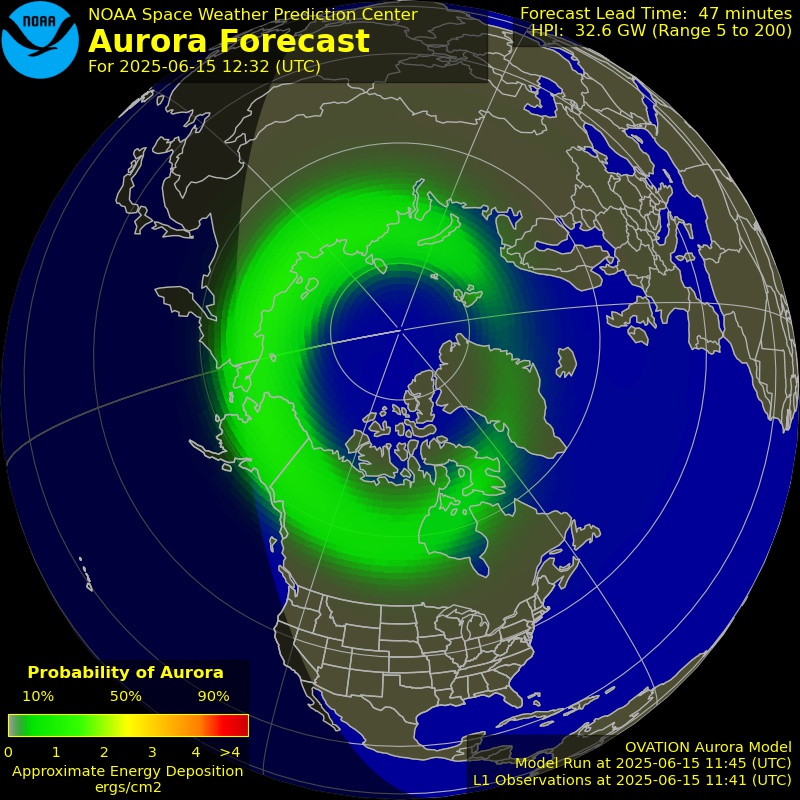
NOAA’s OVATION model gives a regional aurora outlook, normally 30–90 minutes ahead. It does not guarantee a sighting. Check the forecast time printed on the map.
Give yourself a better view
Choose a safe, dark location, check cloud cover, let your eyes adjust and keep expectations realistic. Never stop on an active road to watch the sky.
NOAA’s aurora viewing tipsUnderstand the signals
Does Kp tell me whether I’ll see the aurora?
Kp describes planetary geomagnetic activity. It cannot account for your clouds, darkness or exact viewing conditions.
Is this an aurora camera?
No. The map is a forecast. If upstream solar-wind data are unavailable, NOAA may use a Kp-based estimate with no forecast lead time.
Future space-weather features
Saved aurora locations and aviation views are being explored. These features and feature-update email signup are not currently available. Weather warning signup is separate and remains free.
Get severe-weather alerts · Send feature feedback
For flight planning, use official aviation weather information at AviationWeather.gov. This page is not a flight briefing.